Arctic Warms Seals Vanish Icebergs melt « Thread Started on Feb 21, 2011, 6:00pm »
After being read 3,577 times elsewhere since December 2009 most of this informative thread is now reposted here.
Headline from
The Washington Post November 2nd, 1922.
Arctic Ocean Getting Warm; Seals Vanish and Icebergs Melt.
(The newspaper article was located in the Library of Congress archives by James Lockwood.)
I have taken the trouble to type out the archive report from a grainy newspaper clipping which was the basis for the above headline because it is so interesting in view of the present hysteria concerning contemporary arctic sea ice melt
November, 1922. MONTHLY WEATHER REVIEW
THE CHANGING ARCTIC BY George Nicolas Ifft
(under date of October 10, 1922, the American Consul in Norway submitted the following report to the State Department, Washington, D.C.)
The Arctic seems to be warming up. Reports from fishermen, seal hunters, and explorers who sail the seas about Spitzbergen and the eastern Arctic, all point to a radical change in climatic conditions, and hitherto unheard of high temperatures in that part of the earth’s surface.
In August, 1922, the Norwegian Department of Commerce sent an expedition to Spitzbergen and Bear island under the leadership of Dr Adolf Hoel, lecturer on geology at the University of Christiana. Its purpose was to survey and chart the lands adjacent to the Norwegian mines on those islands, take soundings of the adjacent waters, and make other oceanographic investigations.
Dr Hoel, who has just returned, reports the location of hitherto unknown coal dposits on the eastern shors of Advent Bay - deposits of vast extent and superior quality. This is regarded as of first importance, as so far most of the coal mined by the Norwegian companies on those islands has not been of the best quality.
The oceanographic observations have, however, been even more interesting. Ice conditions were exceptional. In fact, so little ice has never before been noted. The expedition all but established a record, saling as far north as 81 degrees 29 minutes in ice-free water. This is the farthest north ever reached with modern oceanographic apparatus.
The character of the waters of the great polar basin has heretofor been practically unknown. Dr Hoel reports that he made a section of the Gulf Stream at 81 degrees north latitude and took soundings to a depth of 3,100 meters. These show the Gulf Stream very warm, and it could be traced as a surface current till beyond the 81st parallel. The warmth of the waters makes it probable that the favorable ice conditions will continue for some time.
Later a section was taken of the Gulf Stream off Bear Island and off the Isfjord, as well as a section of the cold current that comes down along the west coast of Spitbergen off the south cape.
In connection with Dr Hoel’s report, it is of interest to note the unusually warm summer in Arctic Norway and the observations of Capt. Martin Ingebrigtsen, who has sailed the eastern Arctic for 54 years past. He says that he first noted warmer conditions in 1918, that since that time it has steadily gotten warmer, and that today the Arctic of that region is not recognizable as the same Arctic region of 1868 to 1917.
Many old landmarks are so changed as to be unrecognizable. Where formerly great masses of ice were found, there are now often morraines, accumulations of earth and stones. At many points where glaciers formerly extended far into the sea they have entirely disappeared.
The change in the temperature, says Capt. Ingebrigtsen, has also brought about great change in the flora and fauna of the Arctic. This summer he sought for white fish in Spitsbergen waters. Formerly great shoals of them were found here. This year he saw none, although he visited all the old fishing grounds.
There were few seal in Spitzbergen waters this year, the catch being far under the average. This, however, did not surprise the captain. He pointed out that formerly the waters about Spitzbergen held an even summer temperature of about 3 degrees Celsius; this year recorded temperatures of about 15 dgrees Celsius, and last year the ocean did not freeze over even on the north coast of Spitzbergen.
With the disappearance of white fish and seal has come other life in these waters. This year herring in great shoals were found along the west coast of Spitzbergen, all the way from the fry to the veritable great herring. Shoals of smelt were also met with.
Isn’t the internet wonderful - giving people like me access to this fabulous historical archive? It is like going back in time. What a privilege to retype this old story here for modern readers to appreciate. I hope you do appreciate it and draw the appropriate conclusions from it.
NB This warming, which was also experienced in Greenland, lasted from 1918 to C1939.
Re: Arctic Warms Seals Vanish Icebergs melt « Reply #1 on Feb 21, 2011, 6:11pm »
Hmmm.
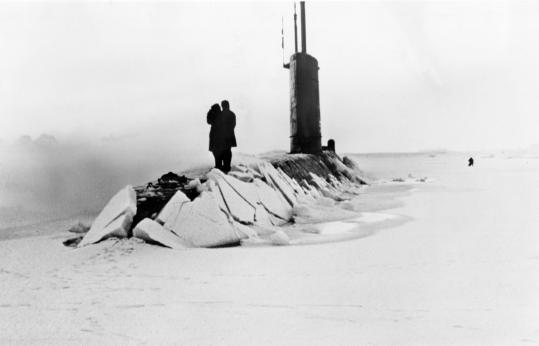
This doesn't look like the 10ft thick ice the silly Pen Hadrow expedition told us used to be the norm for the arctic. This is a photo of a US Atomic sub surfacing at the North Pole c 1958
« Last Edit: Feb 21, 2011, 6:11pm by marchesarosa »
Re: Arctic Warms Seals Vanish Icebergs melt « Reply #2 on Feb 21, 2011, 6:13pm »
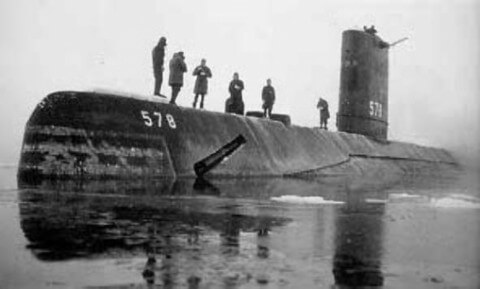
Nor this
It’s 1958. That’s the North Pole. There’s no ice. Gore and his global warming brethren have repeatedly told us that the ice has never been as thin in the arctic as it is today, but this photo tells another story. It’s pretty clear that in 1958 the arctic was…well…pretty clear. Not only did the the Skate surface in virtually ice-free water at the North Pole, but the weather was mild enough that crewmen went out to chip a bit of ice off the sub’s hull.
One crew member aboard the USS Skate which surfaced at the North Pole in 1959 and numerous other locations during Arctic cruises in 1958 and 1959 said:
"the Skate found open water both in the summer and following winter. We surfaced near the North Pole in the winter through thin ice less than 2 feet thick. The ice moves from Alaska to Iceland and the wind and tides causes open water as the ice breaks up. The Ice at the polar ice cap is an average of 6-8 feet thick, but with the wind and tides the ice will crack and open into large polynyas (areas of open water), these areas will refreeze over with thin ice. We had sonar equipment that would find these open or thin areas to come up through, thus limiting any damage to the submarine. The ice would also close in and cover these areas crushing together making large ice ridges both above and below the water. We came up through a very large opening in 1958 that was 1/2 mile long and 200 yards wide. The wind came up and closed the opening within 2 hours. On both trips we were able to find open water. We were not able to surface through ice thicker than 3 feet."
Re: Arctic Warms Seals Vanish Icebergs melt « Reply #6 on Feb 21, 2011, 6:21pm »
"The Russians have been using the Northeast Passage for seventy years.
The records from whaling ships in the arctic record years of almost no ice. I don’t know where you live but if you visit Vancouver, BC and go to their Maritime Museum, they have preserved the ship the St. Roch that routinely made the Northwest Passage during the 20s and 30s.
A couple times it got caught in the ice and had to overwinter but generally, it sailed from Vancouver (British Columbia) to Halifax (Nova Scotia) in one season. And that was while it was stopping at villages and doing work (she was an R.C.M.P. patrol boat) — her voyages were not some mad dash trying to set a record.
E. Hanna1, J. Box, P. Huybrechts Department of Geography, University of Sheffield, UK Byrd Polar Research Center, The Ohio State University, USA Departement Geografie, Vrije Universiteit Brussel, Belgium
Summary "Recent relatively high summer temperatures (1995-2005) are associated with increased net ice loss over Greenland. Recent warm events are about the same magnitude, if not smaller, than those of the early 20th century warm period (1918-1947). 2006 was not as warm as other recent years such as 2003 or 2005. Physical response mechanisms, such as hydraulic acceleration of the ice sheet from continued warming, remain incompletely understood."
.."Over the past century, years in Greenland that register as abnormally warm, 1929, 1932, 1941, 1947, and 1960 are outstanding, having temperatures warmer than observed recently."
« Last Edit: Feb 21, 2011, 6:24pm by marchesarosa »
John Daly's Arctic surface stations « Reply #8 on Feb 21, 2011, 6:25pm »
John L. Daly's plots of non-urban surface station temperature graphs from all round the Arctic Basin. A real eye-opener! NO "unprecendented" warming over more than a century.
.....The scientists observed less perennial ice cover in March 2007 than ever before, with the thick ice confined to the Arctic Ocean north of Canada. Consequently, the Arctic Ocean was dominated by thinner seasonal ice that melts faster. This ice is more easily compressed and responds more quickly to being pushed out of the Arctic by winds. Those thinner seasonal ice conditions facilitated the ice loss, leading to this year's record low amount of total Arctic sea ice.
Nghiem said the rapid decline in winter perennial ice the past two years was caused by unusual winds. "Unusual atmospheric conditions set up wind patterns that compressed the sea ice, loaded it into the Transpolar Drift Stream and then sped its flow out of the Arctic," he said. When that sea ice reached lower latitudes, it rapidly melted in the warmer waters.
"The winds causing this trend in ice reduction were set up by an unusual pattern of atmospheric pressure that began at the beginning of this century," Nghiem said....
« Last Edit: Feb 21, 2011, 6:28pm by marchesarosa »
Arctic Ice Breakers « Reply #10 on Feb 21, 2011, 6:28pm »
The work of ice-breakers by the nations bordering the arctic ocean in keeping shipping lines open may also be implicated in the break up of arctic sea-ice and the ease with which the wind canflush it out of the Polar Basin southwards where it melts.
Changes in Arctic sea-ice, like every other aspect of climate, is an enormously complex interaction of many variables. To try to pin it all on AGW is naive. Perhaps the effect of the ice-breaker is the nearest to an unequivocal "anthropogenic signal" we can find in the arctic.
« Last Edit: Feb 21, 2011, 6:29pm by marchesarosa »
Historical Predictions of Catastrophe « Reply #11 on Feb 21, 2011, 6:30pm »
...many historical accounts published during the past 140 years describing climate changes and often predicting catastrophic cooling or warming.
Here are excerpts from a few of those accounts, appearing as early as 1870:
"The climate of New-York and the contiguous Atlantic seaboard has long been a study of great interest. We have just experienced a remarkable instance of its peculiarity. The Hudson River, by a singular freak of temperature, has thrown off its icy mantle and opened its waters to navigation.” – New York Times, Jan. 2, 1870
“Is our climate changing? The succession of temperate summers and open winters through several years, culminating last winter in the almost total failure of the ice crop throughout the valley of the Hudson, makes the question pertinent. The older inhabitants tell us that the winters are not as cold now as when they were young, and we have all observed a marked diminution of the average cold even in this last decade.” – New York Times, June 23, 1890
“The question is again being discussed whether recent and long-continued observations do not point to the advent of a second glacial period, when the countries now basking in the fostering warmth of a tropical sun will ultimately give way to the perennial frost and snow of the polar regions.” – New York Times, Feb. 24, 1895
Professor Gregory of Yale University stated that “another world ice-epoch is due.” He was the American representative to the Pan-Pacific Science Congress and warned that North America would disappear as far south as the Great Lakes, and huge parts of Asia and Europe would be “wiped out.” – Chicago Tribune, Aug. 9, 1923
“The discoveries of changes in the sun's heat and southward advance of glaciers in recent years have given rise to the conjectures of the possible advent of a new ice age – Time Magazine, Sept. 10, 1923 Headline: “America in Longest Warm Spell Since 1776; Temperature Line Records a 25-year Rise” – New York Times, March 27, 1933 “America is believed by Weather Bureau scientists to be on the verge of a change of climate, with a return to increasing rains and deeper snows and the colder winters of grandfather's day.” – Associated Press, Dec. 15, 1934
Warming Arctic Climate Melting Glaciers Faster, Raising Ocean Level, Scientist Says – “A mysterious warming of the climate is slowly manifesting itself in the Arctic, engendering a "serious international problem," Dr. Hans Ahlmann, noted Swedish geophysicist, said today. – New York Times, May 30, 1937
“Greenland's polar climate has moderated so consistntly that communities of hunters have evolved into fishing villages. Sea mammals, vanishing from the west coast, have been replaced by codfish and other fish species in the area's southern waters.” – New York Times, Aug. 29, 1954
“An analysis of weather records from Little America shows a steady warming of climate over the last half century. The rise in average temperature at the Antarctic outpost has been about five degrees Fahrenheit.” – New York Times, May 31, 1958
“Several thousand scientists of many nations have recently been climbing mountains, digging tunnels in glaciers, journeying to the Antarctic, camping on floating Arctic ice. Their object has been to solve a fascinating riddle: what is happening to the world's ice? – New York Times, Dec. 7, 1958
“After a week of discussions on the causes of climate change, an assembly of specialists from several continents seems to have reached unanimous agreement on only one point: it is getting colder.” – New York Times, Jan. 30, 1961
“Like an outrigger canoe riding before a huge comber, the earth with its inhabitants is caught on the downslope of an immense climatic wave that is plunging us toward another Ice Age.” – Los Angeles Times, Dec. 23, 1962
“Col. Bernt Balchen, polar explorer and flier, is circulating a paper among polar specialists proposing that the Arctic pack ice is thinning and that the ocean at the North Pole may become an open sea within a decade or two." – New York Times, Feb. 20, 1969
“By 1985, air pollution will have reduced the amount of sunlight reaching earth by one half . . . ." – Life magazine, January 1970 “In ten years all important animal life in the sea will be extinct. Large areas of coastline will have to be evacuated because of the stench of dead fish.” – Paul Ehrlich, Earth Day, 1970
"Civilization will end within 15 or 30 years unless immediate action is taken against problems facing mankind. We are in an environmental crisis which threatens the survival of this nation, and of the world as a suitable place of human habitation." – Barry Commoner (Washington University), Earth Day, 1970
Because of increased dust, cloud cover and water vapor, "the planet will cool, the water vapor will fall and freeze, and a new Ice Age will be born.” – Newsweek magazine, Jan. 26, 1970
“The United States and the Soviet Union are mounting large-scale investigations to determine why the Arctic climate is becoming more frigid, why parts of the Arctic sea ice have recently become ominously thicker and whether the extent of that ice cover contributes to the onset of ice ages.” – New York Times, July 18, 1970
“In the next 50 years, fine dust that humans discharge into the atmosphere by burning fossil fuel will screen out so much of the sun's rays that the Earth's average temperature could fall by six degrees. Sustained emissions over five to 10 years, could be sufficient to trigger an ice age." – Washington Post, July 9, 1971
“It's already getting colder. Some midsummer day, perhaps not too far in the future, a hard, killing frost will sweep down on the wheat fields of Saskatchewan, the Dakotas and the Russian steppes. . . .” – Los Angles Times, Oct. 24, 1971
“An international team of specialists has concluded from eight indexes of climate that there is no end in sight to the cooling trend of the last 30 years, at least in the Northern Hemisphere.” – New York Times, Jan. 5, 1978
“A poll of climate specialists in seven countries has found a consensus that there will be no catastrophic changes in the climate by the end of the century. But the specialists were almost equally divided on whether there would be a warming, a cooling or no change at all.” – New York Times, Feb. 18, 1978
“A global warming trend could bring heat waves, dust-dry farmland and disease, the experts said... Under this scenario, the resort town of Ocean City, Md., will lose 39 feet of shoreline by 2000 and a total of 85 feet within the next 25 years.” – San Jose Mercury News, June 11, 1986
“Global warming could force Americans to build 86 more power plants -- at a cost of $110 billion -- to keep all their air conditioners running 20 years from now, a new study says...Using computer models, researchers concluded that global warming would raise average annual temperatures nationwide two degrees by 2010, and the drain on power would require the building of 86 new midsize power plants – Associated Press, May 15, 1989
“New York will probably be like Florida 15 years from now.” -- St. Louis Post-Dispatch, Sept. 17, 1989
"[By] 1995, the greenhouse effect would be desolating the heartlands of North America and Eurasia with horrific drought, causing crop failures and food riots . . . [By 1996] The Platte River of Nebraska would be dry, while a continent-wide black blizzard of prairie topsoil will stop traffic on interstates, strip paint from houses and shut down computers . . . The Mexican police will round up illegal American migrants surging into Mexico seeking work as field hands.” – "Dead Heat: The Race Against the Greenhouse Effect," Michael Oppenheimer and Robert H. Boyle, 1990.
"It appears that we have a very good case for suggesting that the El Ninos are going to become more frequent, and they're going to become more intense and in a few years, or a decade or so, we'll go into a permanent El Nino. So instead of having cool water periods for a year or two, we'll have El Nino upon El Nino, and that will become the norm. And you'll have an El Nino, that instead of lasting 18 months, lasts 18 years,” according to Dr. Russ Schnell, a scientist doing atmospheric research at Mauna Loa Observatory. – BBC, Nov. 7, 1997
"Scientists are warning that some of the Himalayan glaciers could vanish within ten years because of global warming. A build-up of greenhouse gases is blamed for the meltdown, which could lead to drought and flooding in the region affecting millions of people." -- The Birmingham Post in England, July 26, 1999
“This year (2007) is likely to be the warmest year on record globally, beating the current record set in 1998.” – ScienceDaily, Jan. 5, 2007
Arctic warming has become so dramatic that the North Pole may melt this summer (2008), report scientists studying the effects of climate change in the field. "We're actually projecting this year that the North Pole may be free of ice for the first time [in history]," David Barber, of the University of Manitoba, told National Geographic News aboard the C.C.G.S. Amundsen, a Canadian research icebreaker. – National Geographic News, June 20, 2008
"So the climate will continue to change, even if we make maximum effort to slow the growth of carbon dioxide. Arctic sea ice will melt away in the summer season within the next few decades. Mountain glaciers, providing fresh water for rivers that supply hundreds of millions of people, will disappear - practically all of the glaciers could be gone within 50 years. . . Clearly, if we burn all fossil fuels, we will destroy the planet we know . . . We would set the planet on a course to the ice-free state, with sea level 75 metres higher. Climatic disasters would occur continually." Dr. James Hansen (NASA GISS), The Observer, Feb. 15, 2009. * * * Climate change? Yes, there has been plenty of that during the past 140 years. Despite warnings by "experts of the day" of approaching climate disasters, mankind somehow managed to survive. A decade or so from now, after earth's climate changes once again, those who are old enough will recall with amusement the time, early in the 21st century, when the world went crazy over an imaginary threat called “global warming.”
Kirk Myers' columns appear several times weekly. To receive e-mail alerts when new articles are published, click on the "subscribe" button above. For a comprehensive look at global warming, please see the list of links to the right.
Doesn't it make you think that the only thing that differentiates current climate alarmism from that of previous eras is that today there is a damned sight more money backing the scaremongering and many more financial and economic interests now have a stake in promoting it..
Apart from that I can't see much difference myself.
« Last Edit: Feb 21, 2011, 6:31pm by marchesarosa »
Re: Arctic Warms Seals Vanish Icebergs melt « Reply #12 on Feb 21, 2011, 6:33pm »
Hey, folks, do any of you compute the statistics of visits to the board and/or to particular threads?
I do.
In particular I follow the ratio of "replies to views" on a particular thread. Usually, the ratio averages about 10 at the most. For example, the highly tendentious and therefore "popular" thread "Blokes are crap survey reveals" is currently running at 49 replies to 423 views, a ratio of 8.6. And "Spying on home educating parents" is now 45 replies to 438 views, a ratio of 9.7.
That's as good as it gets in the "Discussions Room" at The Sequal.
HOWEVER, I have the honour to announce that this thread "Arctic Warms Seals Vanish Icebergs melt" with only 14 posts (all from me, I think) NOW boasts 554 577 608 631 675 725 views! A ratio of 42.6 43.4 45.1 !!! I've given up working out the ratio!
This is a board record and is almost entirely due to "visitors from abroad", as it were. the number of views is now a very satisfying 3,577! (as of 21 Feb 2011)
Thanks guys! I hope the message is getting home. It is a pretty revealing thread that deserves the oxygen of publicity.
Thanks for lookin'.
« Last Edit: Feb 21, 2011, 6:34pm by marchesarosa »
Hubert Lamb - Founder of CRU « Reply #13 on Feb 21, 2011, 6:35pm »
Quote from Hubert Lamb, (founder of the CRU) “Climate Present, Past, and Future,” vol. 2 page 516:
“There was a period of severe ice on the SE coast of Greenland even in the spring of 1938 owing to the exceptional rapidity of the outflow of ice from near the North Pole (fig. 7.4 vol. 1). The late summer of that year saw the most extensive open water ever known north of the coast of Asia.”
It seems as though someone was measuring the ice (or lack of it) in 1938.
« Last Edit: Feb 21, 2011, 6:36pm by marchesarosa »